

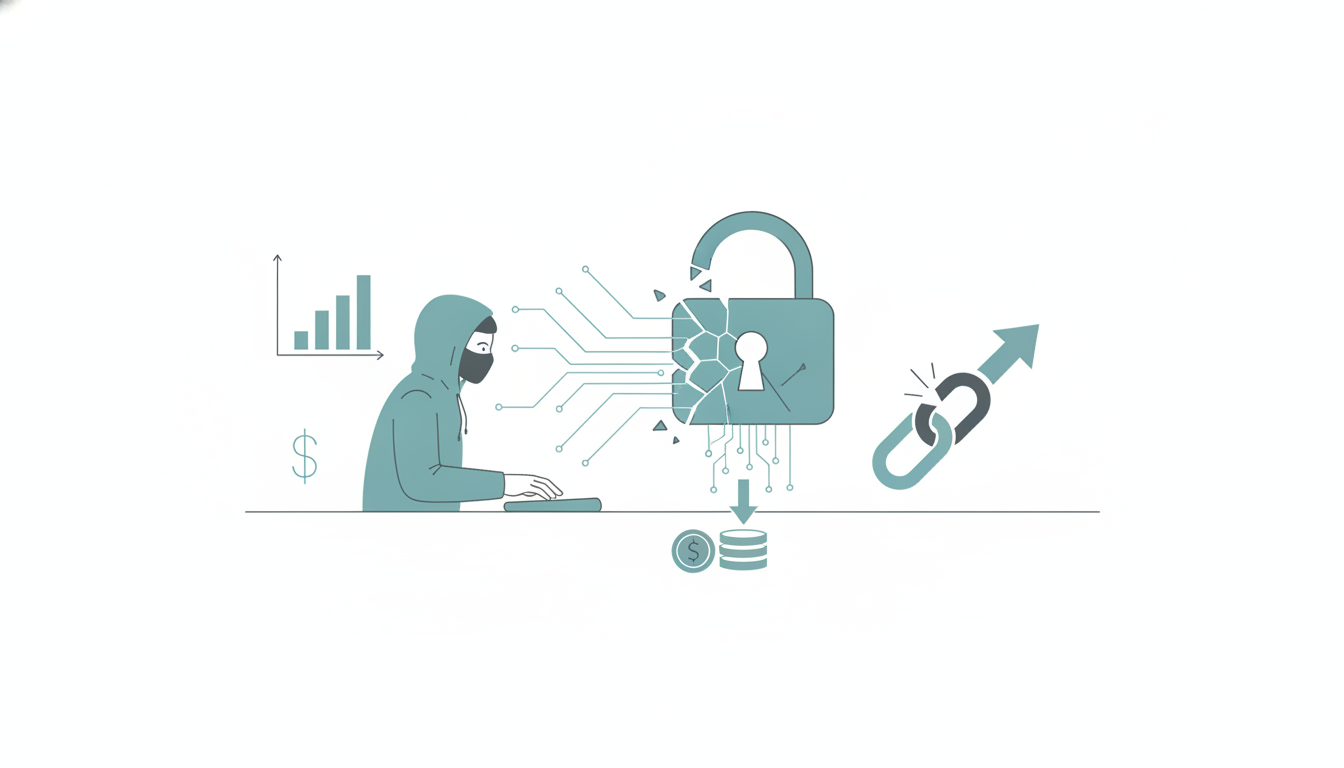
The Bitget security breach is shaping up to be one of the ugliest exchange hacks in recent memory — not just because of the $388 million price tag, but because of how methodically the attackers have dismantled every attempt to stop them. What started as a devastating theft has become a live case study in how far crypto’s laundering infrastructure has evolved, and how poorly the ecosystem is equipped to respond.
How the Bitget Security Breach Actually Unfolded
This wasn’t a smash-and-grab. According to blockchain security firm SlowMist, malicious activity tied to the breach traces back to a zero-day exploit first detected on August 31 — weeks before the theft was publicly acknowledged. The attackers used two compromised security products and a custom-built withdrawal tool to move funds without triggering standard alarms. That level of preparation doesn’t come from opportunists. This was a targeted, patient operation.
The breach ultimately resulted in $387.5 million in user losses, making it the dominant story in what Cointelegraph reports was the worst month for crypto hacks in all of 2026, with September totaling over $768 million in losses. A separate $320 million Liquid Network exploit also hit during the same period, though more than $270 million from that incident was eventually returned. The Bitget funds? Those are a different story entirely.
Every Exit Route Gets Blocked — Then They Find Another
The laundering trail here is worth following closely, because it reveals exactly how sophisticated the post-theft playbook has become. Initial attempts to move funds through CoW Protocol and Chainflip were partially disrupted — Chainflip outright rejected a deposit tied to the theft and returned the funds rather than processing the swap. That’s the good news.
The attackers then pivoted to THORChain, routing significant volume through the decentralized cross-chain protocol. This is where things get legally murky. Crypto lawyer Yuriy Brisov notes that THORChain’s developers face potential prosecution exposure, but the decentralized structure makes liability genuinely difficult to pin down. THORChain’s inability — or unwillingness — to block flagged addresses isn’t a new controversy, but this breach has pushed that debate to a new level of urgency.
Near Intents then blocked roughly $50 million in attempted swaps, forcing yet another route change. That’s when the attackers moved to Zcash. On-chain investigator ZachXBT flagged three transactions totaling approximately 2,746 ZEC — around $3.9 million — flowing into Zcash’s Ironwood shielded pool. Once inside that privacy pool, tracing becomes exponentially harder. Decrypt confirmed the attacker used Zcash’s Ironwood pool specifically after the Near Intents route was shut down — a deliberate escalation toward the most opaque available tool.
CoinDesk reported that the Zcash move makes tracing the funds significantly harder for investigators — which is exactly the point. The attackers aren’t rushing. They’re cycling through infrastructure systematically, abandoning each route the moment it closes and moving to the next layer of obfuscation.

Bitget’s Protection Fund Absorbs the Hit — But Questions Remain
To Bitget’s credit, the exchange didn’t collapse. CEO Gracy Chen stated that a protection fund established in 2022 “absorbed the financial impact of the incident,” with the fund reaching $309 million at the time of reporting. Operations were described as gradually returning to normal.
That’s a meaningful response. Having a reserve fund that can cover a nine-figure breach without freezing withdrawals is exactly the kind of infrastructure that separates exchanges built to last from those that fold under pressure. The $309 million figure is close enough to the loss amount that it clearly required significant deployment of reserves — this wasn’t a comfortable buffer, it was a stress test that the fund narrowly passed.
Still, the fact that a zero-day exploit sat undetected for weeks before triggering the theft raises harder questions about internal monitoring. The protection fund addressed the financial damage. It doesn’t address the detection failure. If you’re currently holding funds on any centralized exchange — including Bitget — now is a reasonable time to revisit how much you’re keeping on-platform versus in self-custody.
The Bigger Problem: DeFi Infrastructure as a Laundering Layer
What this breach really exposes is the degree to which permissionless DeFi protocols have become integral to post-hack laundering. THORChain, CoW, Chainflip, Near Intents, and now Zcash’s privacy pool — these aren’t obscure tools. They’re legitimate infrastructure used by millions of real traders daily. The fact that they also function as sequential laundering stages for nearly $400 million in stolen funds is a regulatory and reputational problem the DeFi space hasn’t seriously reckoned with yet.
Some protocols acted responsibly — Chainflip returned funds, Near Intents blocked swaps. Others either couldn’t or wouldn’t act. The patchwork nature of that response is exactly what regulators will point to when arguing for stricter oversight of decentralized protocols. Whether that’s the right policy answer is debatable. But the optics are brutal, and the September hack numbers — over $768 million lost in a single month — aren’t going to help the industry’s case for self-regulation.
For traders and exchange users watching this play out, keep an eye on our crypto news hub as this investigation continues — the fund movement trail is still active and new developments are emerging regularly.
My Read on This
Here’s what I actually think: the Zcash pivot is significant beyond just this case. It signals that sophisticated attackers are becoming faster at adapting their laundering routes as the industry improves its blocking infrastructure. The window between exploit and obfuscation is shrinking. Near Intents blocking $50 million was genuinely impressive coordination — but within days the attackers had already pivoted to a privacy pool that investigators have far fewer tools against.
The risk I’d watch here isn’t Bitget specifically — they survived this, and their protection fund model deserves some genuine credit. The risk is contagion in perception. When September produces $768 million in hacks and the worst-case laundering tools are clearly still one step ahead of recovery efforts, institutional money notices. Not enough to derail the cycle, but enough to slow the kind of exchange-level inflows that drive real volume growth. If you’re trading on a centralized platform right now, size your on-exchange balance accordingly — keep what you need for active positions, nothing more. This breach won’t be the last.
Popular Exchange Referral Codes
- Bybit Referral Code 2026: Get 20% Fee Discount for 90 Days with Code 19670
- Bitget Referral Code 2026: Get 20% Trading Fee Discount with Code t4685009
- OKX Referral Code 2026: Get 20% Trading Fee Discount with Code 64912533
- HTX Referral Code 2026: Get 20% Trading Fee Discount with iddq7223
- Gate.io Referral Code 2026: Get a 20% Trading Fee Discount with Code NZRAPCBW


