

SBI Group’s Coinhako Acquisition Signals a New Era for Asian Digital Asset Markets
SBI Group’s Coinhako acquisition is one of the most consequential moves in Asian crypto this year — a regulated, bank-backed Japanese conglomerate planting its flag in Singapore’s licensed exchange landscape. For traders who’ve watched institutional money circle the digital asset space for years, this is the move that makes it real at a regional scale.
What Happened: SBI Takes a Majority Stake in Coinhako
SBI Holdings, the Japanese financial giant with deep roots in traditional banking and securities, has completed a majority acquisition of Coinhako, one of Singapore’s licensed crypto exchanges. The deal closed following approval from the Monetary Authority of Singapore (MAS) — a regulatory green light that carries significant weight, given how selectively Singapore has issued digital payment token service licenses.
According to The Block, SBI folded Coinhako directly into its expanding digital asset network, treating Singapore as a strategic node rather than a standalone investment. This isn’t a passive minority stake — SBI now controls the platform and its regulatory infrastructure.
Cointelegraph notes that the acquisition positions SBI to expand into stablecoins, onchain finance, and tokenized assets — areas where Singapore’s regulatory environment offers a meaningful advantage over Japan’s more restrictive framework. The Coinhako platform gives SBI an already-licensed, operational base from which to build those products without starting from scratch.
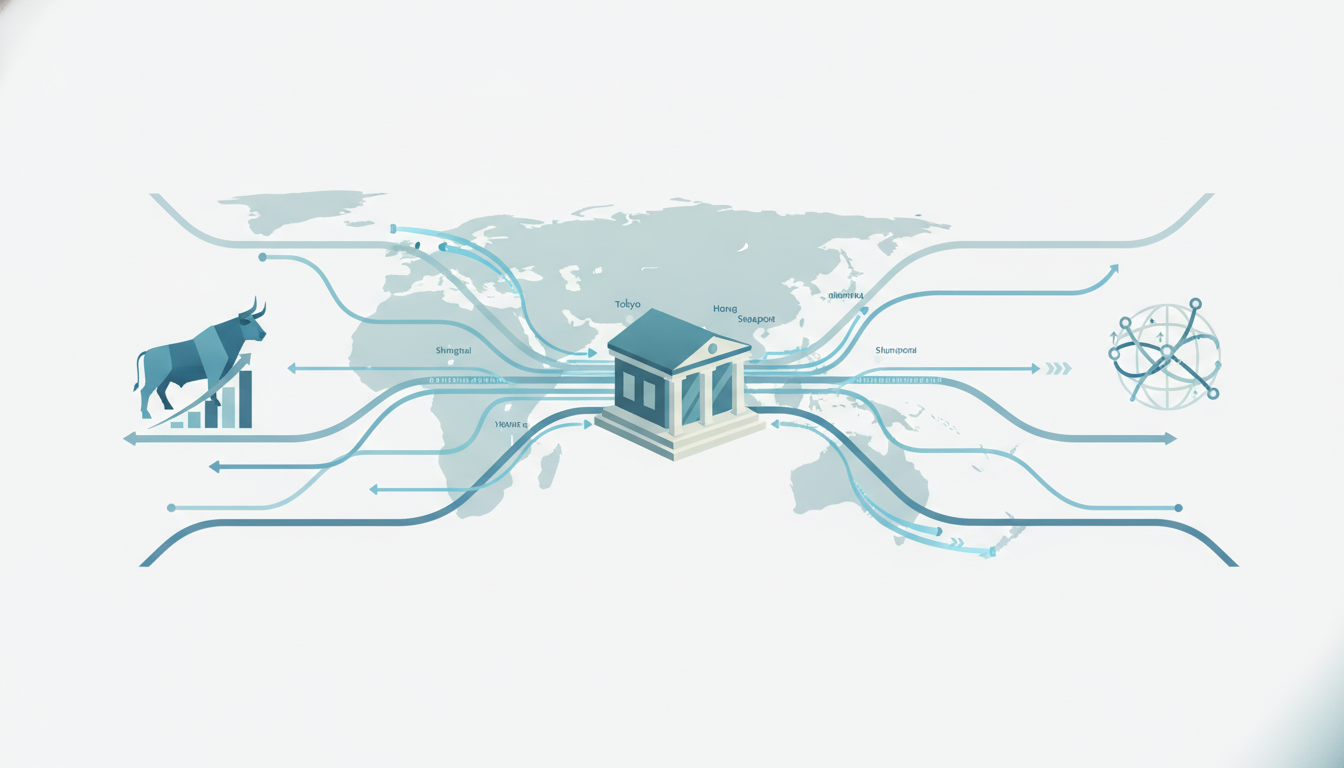
Bitcoin Magazine frames this as part of SBI’s broader ambition to build a cross-border digital asset network spanning Japan and Southeast Asia — a connected system of exchanges, custodians, and financial infrastructure rather than a collection of isolated bets.
And CoinDesk puts it most bluntly, framing SBI as building what could be Asia’s first cross-border digital asset empire — a term that feels less hyperbolic the more you look at the pieces already in place.

Why It Matters: Institutional Architecture at Regional Scale
This deal matters for several reasons that go beyond a single acquisition headline.
Regulatory Arbitrage, Done Properly
Japan’s crypto rules are rigorous — famously so after the Mt. Gox and Coincheck incidents. Singapore’s MAS framework is equally serious but structured differently, with more openness toward stablecoin issuance and tokenized financial products. By holding licensed infrastructure in both jurisdictions, SBI can route products and capital in ways that a single-country operation simply cannot. That’s regulatory arbitrage executed through compliance rather than avoidance — and it’s a template other institutional players will study closely.
The Coinhako Asset Is More Than a Brand
Coinhako holds a Major Payment Institution license under MAS — a credential that took years and significant operational scrutiny to obtain. SBI didn’t just buy a user base; it bought a regulatory passport into Southeast Asia’s most credible financial hub. For a conglomerate with SBI’s resources, the license is arguably worth more than the trading volume.
Tokenization Is the Real Target
Read between the lines of Cointelegraph’s reporting and the strategic priority becomes clear: stablecoins and tokenized assets. Singapore has been actively courting institutional-grade tokenization projects — from tokenized bonds to cross-border settlement rails. SBI’s expanded footprint positions it to participate in, and potentially underwrite, those markets. That’s not a crypto-native play; that’s a traditional financial institution using crypto infrastructure to capture the next wave of capital markets.
If you’re tracking where institutional money is building long-term infrastructure, this belongs on your watchlist alongside your current exchange referral offers and fee structures — because the platforms these institutions build tend to define where retail liquidity follows.
Market Context: Where Prices Stand as the Deal Closes
Markets are trading with modest mixed momentum as this story develops. Bitcoin is at $63,939, up just under 1% in the last 24 hours — holding support but not yet showing the kind of conviction breakout that would signal a fresh institutional wave is hitting spot markets. Ethereum sits at $1,842.99, essentially flat with a -0.1% drift, which is notable given that ETH’s tokenization and stablecoin narrative should theoretically benefit from exactly the kind of infrastructure SBI is building. Solana is at $75.16, up 0.42%, continuing its quiet grind.
The disconnect between this macro-level institutional story and subdued spot prices is worth noting. Moves like SBI’s Coinhako acquisition don’t pump prices on announcement day — they build the rails that future volume rides on. Traders focused on short-term momentum may underweight this; those with a longer timeframe should not.
What Different Outlets Are Saying
The coverage gap across outlets is revealing in itself.
CoinDesk leads with the empire-building angle — framing SBI’s moves as a deliberate, systemic effort to dominate cross-border digital finance in Asia. It’s the most expansive read, situating Coinhako as one piece of a much larger puzzle that includes SBI’s existing stakes in crypto ventures across Japan and beyond.
Cointelegraph anchors the story in regulatory process, emphasizing the MAS approval as the pivotal event. Their framing treats the deal primarily as a compliance story — which is accurate, but undersells the strategic ambition. Their reporting confirms that SBI is targeting stablecoins and onchain finance as primary growth vectors post-acquisition.
The Block is characteristically terse and transactional — focused on the mechanics of the deal completion and the integration into SBI’s existing network. Useful for facts, lighter on strategic interpretation.
Bitcoin Magazine, writing for a Bitcoin-native audience, emphasizes the cross-border network angle and SBI’s push into Southeast Asia. Their framing is closest to CoinDesk’s in ambition, though the piece is more concise. As Bitcoin Magazine puts it, SBI is “strengthening its push to build a cross-border digital asset network.”
Taken together, the outlets agree on the facts but diverge on emphasis: regulatory milestone vs. strategic empire-building vs. network infrastructure play. All three frames are correct — which is precisely what makes this deal more significant than a typical acquisition headline.
Trader Takeaway
SBI’s Coinhako acquisition isn’t a trade signal — it’s a structural signal. When a 20-year-old financial conglomerate with banking, securities, and insurance arms starts buying licensed crypto exchanges across jurisdictions, the question isn’t whether institutional adoption is happening; it’s which infrastructure layer captures the most value when it does. Keep an eye on how SBI develops Coinhako’s stablecoin and tokenization capabilities over the next 12 to 18 months — that’s where the real story will be written. For traders evaluating where to hold assets and access liquidity, monitoring which platforms are building under regulatory approval versus operating in grey zones is increasingly the most important due-diligence variable. Check our crypto news and market insights hub for ongoing coverage as SBI’s Asian strategy develops.
Popular Exchange Referral Codes
- Bybit Referral Code 2026: Get 20% Fee Discount for 90 Days with Code 19670
- Bitget Referral Code 2026: Get 20% Trading Fee Discount with Code t4685009
- OKX Referral Code 2026: Get 20% Trading Fee Discount with Code 64912533
- HTX Referral Code 2026: Get 20% Trading Fee Discount with iddq7223
- Gate.io Referral Code 2026: Get a 20% Trading Fee Discount with Code NZRAPCBW


