
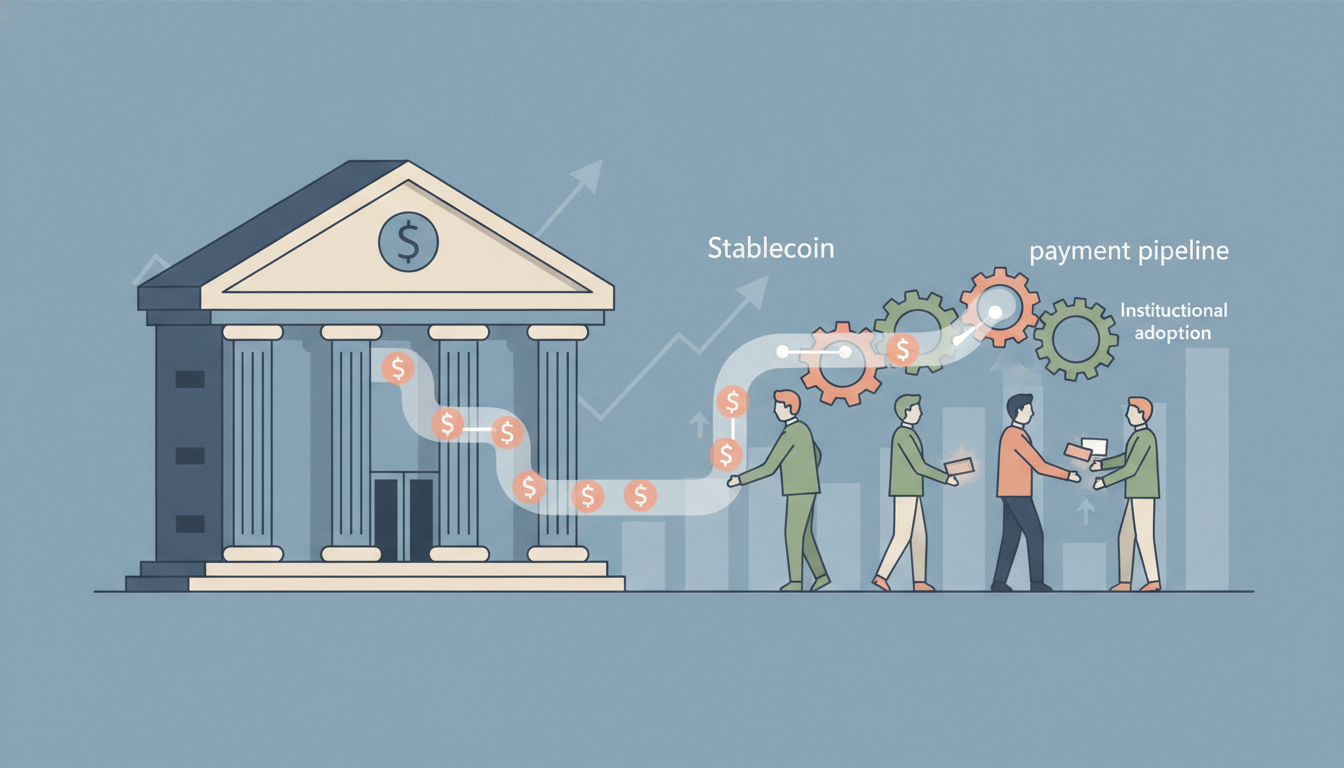
Stablecoin Market Growth Is No Longer a Debate — It’s an Infrastructure Race
Stablecoin market growth has crossed a threshold that even the most skeptical Wall Street veterans can no longer ignore: June 2026 saw stablecoin transaction volume hit a record $1.79 trillion, a figure that puts tokenized dollars squarely in the same conversation as legacy payment rails. The question institutions are now wrestling with isn’t whether stablecoins belong in finance — it’s who builds the plumbing first, and who controls it.
What Happened: Record Volume, Banking Capitulation, and a $2B Power Play
The headline number is striking on its own. According to Cointelegraph, stablecoin transaction volume reached $1.79 trillion in June — a record high that signals the asset class has moved well beyond speculative trading into genuine utility. Crypto researcher Nick Ruck noted that stablecoins are “maturing and positioned for even greater reach.”
On the institutional side, traditional banks have undergone a quiet but significant mindset shift. Reporting from CoinDesk captures this succinctly: the conversation inside major financial institutions has moved from whether stablecoins belong in finance to how they get integrated. That is not a subtle distinction. Banks that spent years dismissing crypto settlements are now mapping onboarding frameworks, custody solutions, and regulatory compliance pathways for tokenized dollar instruments.
Meanwhile, in what may be the most strategically loaded deal of the quarter, Binance has reportedly led a $2 billion investment round into Mesh — a payments infrastructure company that connects wallets to merchants. As CryptoSlate frames it, the signal isn’t about yield or market cap — it’s about who controls the wallet-to-merchant path that makes tokenized dollars actually spendable at point of sale. That’s the last mile problem, and Binance appears to be betting $2 billion that solving it is worth more than any stablecoin yield product.

Why It Matters: Collateral Quality and Infrastructure Ownership Will Define Winners
The record volume number is the attention-grabber, but the deeper story is about architecture. A separate CoinDesk opinion piece makes a point that traders should take seriously: yield is a feature, but collateral is the foundation. In a market where a dozen stablecoin issuers are competing for dominance, the ones backed by the highest-quality, most transparent reserves will ultimately command institutional trust — and institutional volume.
This matters enormously for the DeFi ecosystem. As stablecoin market growth attracts banks and payment processors, the protocols and platforms that hold inferior or opaque collateral will face a credibility squeeze. Regulators — particularly in the U.S. and EU — are already scrutinizing reserve compositions. A stablecoin that competes on yield alone is exposed the moment its collateral structure comes under a microscope.
The Binance-Mesh dynamic adds another layer. Control of payment routing infrastructure is a different kind of moat than issuing a stablecoin. If Mesh becomes the dominant wallet-to-merchant bridge, Binance effectively earns a toll position on a significant chunk of stablecoin commerce — regardless of which stablecoin wins the collateral race. That’s a classic platform play, and it’s one DeFi protocols built purely on-chain are not well-positioned to replicate.
For traders and DeFi participants who want to stay ahead of these structural shifts, keeping tabs on the latest crypto market developments is increasingly essential — these infrastructure deals move fast and reprice assets faster.
Market Context: Macro Calm, But Stablecoin Signals Point Beneath the Surface
Spot markets are trading in a relatively tight range as of this writing. Bitcoin is at $63,008 (up 0.56% over 24 hours), Ethereum is at $1,771 (up 0.47%), and Solana is flat at $80.35. On the surface, this looks like a low-volatility consolidation phase.
But the stablecoin story tells a different tale beneath the price action. Record transaction volumes in a month where BTC and ETH were not making parabolic moves suggests that stablecoin flows are increasingly independent of spot market sentiment. Traders are using tokenized dollars for settlement, cross-border transfers, DeFi yield, and now point-of-sale payments — not just as a parking spot during bear markets. That structural shift in stablecoin utility is the real signal here, and it has long-term implications for how liquidity flows through the crypto ecosystem.
What Different Outlets Are Saying: Three Angles, One Convergent Trend
It’s worth stepping back and noting how differently each outlet is framing the same macro trend — because the angle tells you something about who their audience is and what risks they’re foregrounding.
CoinDesk: Institutional Legitimacy Is the Story
Both CoinDesk pieces are oriented toward institutional readers. The banking integration piece treats the “how not whether” framing as a landmark moment — and it is. But CoinDesk’s opinion on collateral is arguably the more important read for serious traders. The argument that reserve quality, not APY, will determine which stablecoins achieve long-term dominance is a thesis that runs counter to how most retail DeFi participants currently evaluate yield-bearing stablecoins. It’s a contrarian take with strong fundamental logic.
Cointelegraph: The Volume Milestone Gets Top Billing
Cointelegraph leads with the $1.79 trillion figure, which is the right call for reach and shareability. The framing emphasizes maturation and future growth potential, positioning stablecoins as a rising asset class rather than a niche tool. For traders, the volume data point is useful for benchmarking adoption velocity — but the piece doesn’t dig deeply into which stablecoins are driving those flows, which is the critical follow-up question.
CryptoSlate: Infrastructure Control Is the Real Prize
CryptoSlate’s angle on the Binance-Mesh deal is the most strategically rich of the three framings. Rather than celebrating volume or legitimacy, it asks a harder question: who owns the pipes? That infrastructure-first perspective is closer to how venture capitalists and exchange strategists think about this space. The answer to that question — which entity controls the wallet-to-merchant routing layer — may matter more to stablecoin adoption outcomes than any regulatory approval or reserve audit.
Trader Takeaway
From a veteran trading perspective, the convergence of record stablecoin volume, banking sector capitulation, and aggressive infrastructure investment by exchanges like Binance is not a coincidence — it’s a maturation signal that typically precedes a significant repricing of related assets. The collateral quality argument from CoinDesk deserves a place in every DeFi portfolio review: chase yield carelessly in this environment and you may be holding the wrong stablecoin when regulators or markets demand transparency. Traders evaluating which exchanges offer the best stablecoin-denominated products and rewards should review our up-to-date exchange comparisons before committing liquidity.
Popular Exchange Referral Codes
- Bybit Referral Code 2026: Get 20% Fee Discount for 90 Days with Code 19670
- Bitget Referral Code 2026: Get 20% Trading Fee Discount with Code t4685009
- OKX Referral Code 2026: Get 20% Trading Fee Discount with Code 64912533
- HTX Referral Code 2026: Get 20% Trading Fee Discount with iddq7223
- Gate.io Referral Code 2026: Get a 20% Trading Fee Discount with Code NZRAPCBW


